


Why Cloud Forest Plants Need Different Soil Conditions
Cloud forest epiphytes evolved in a very specific environment — the cool, fog-drenched montane forests of regions like Ecuador and Colombia, where daily humidity often reaches saturation, temperatures stay mild, and roots experience near-constant atmospheric moisture combined with continuous airflow. These plants never evolved for dry periods. They evolved for perpetual, oxygenated humidity.
Their root systems — often thin, delicate, and highly sensitive — are adapted for surfaces like tree bark and moss where moisture is always present but never stagnant. Conventional potting soils become too dense and too anaerobic for these species. They compact, restrict oxygen, and hold the wrong kind of moisture — sustained saturation rather than the oxygenated, atmospheric humidity cloud forest roots developed for.
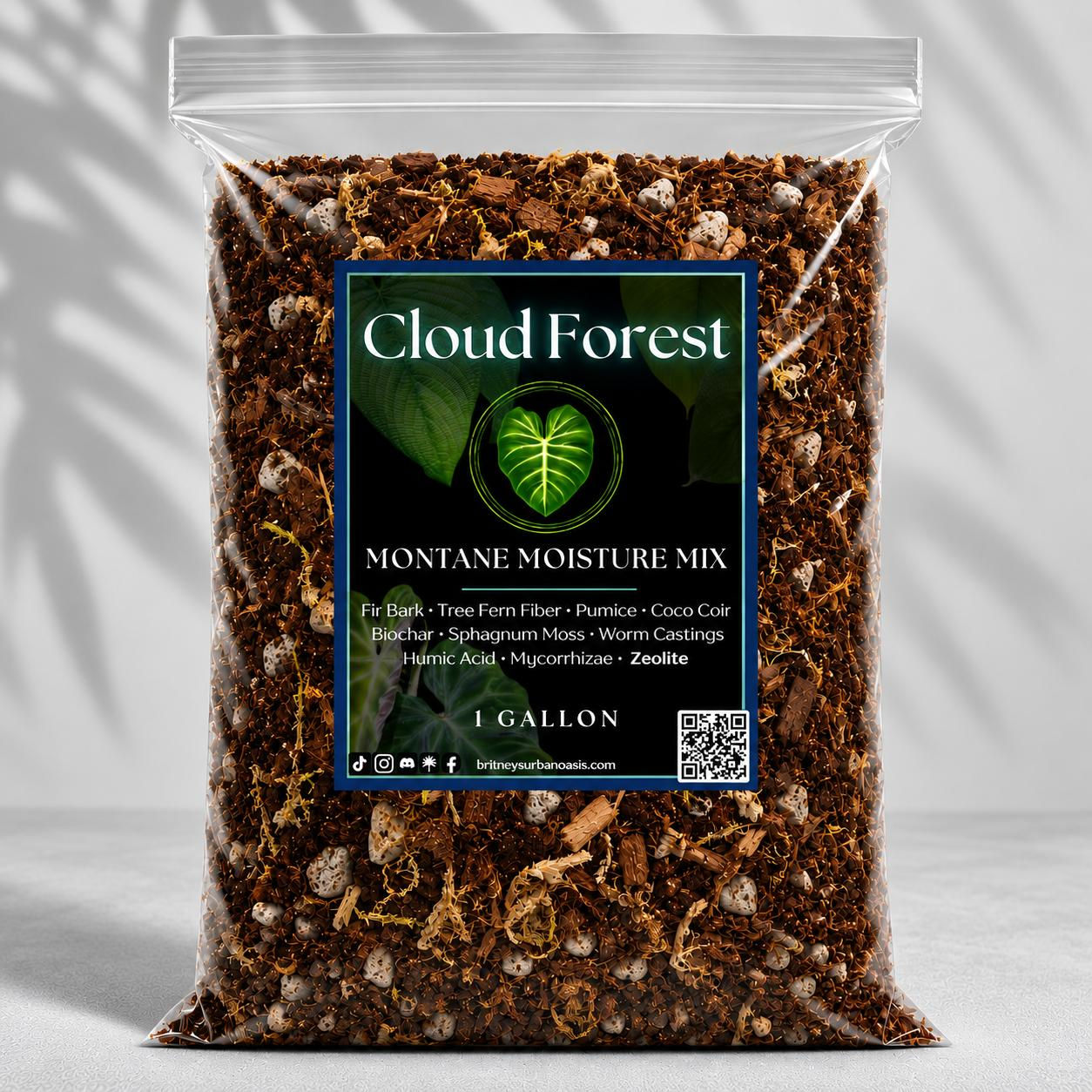
Cloud Forest Mix was designed to bridge that gap. It is the most moisture-retentive mix in our lineup that still maintains genuine oxygen availability throughout the substrate — creating the humidity-rich, continuously aerated root zone that velvety aroids, bullate philodendrons, and thin-rooted tropical epiphytes thrive in.
How This Mix Performs Differently
Consistent Humidity at the Root Level
Cloud forest species do not just want ambient humidity — they need it at the root zone. Sphagnum moss and tree fern fiber maintain a persistently humid microenvironment around roots, replicating the fog-drenched conditions these plants evolved in without creating the waterlogged, oxygen-poor conditions that cause rapid root decline in sensitive species.
Oxygen Exchange in a Moisture-Rich System
This is the challenge most high-humidity mixes fail to solve. Dense, moisture-retentive substrates eventually restrict the oxygen availability that epiphytic roots require. Cloud Forest Mix uses pumice, fir bark, and coco chips as structural components that maintain open airflow channels throughout the mix — even when moisture levels are high.
Long-Term Structural Stability for Sensitive Root Systems
Cloud forest species are often slow growers that spend years in the same container. This mix is engineered for long-term structural integrity — resisting compaction and maintaining its aerated, moisture-balanced architecture for the extended periods between repotting events that sensitive collector species prefer.
Biologically Active Root Zone
Mycorrhizae, trichoderma, lactobacillus, biochar, and worm castings create a biologically rich substrate that supports root colonization, nutrient cycling, and rhizosphere development — converting the growing medium from an inert substrate into a living root environment. This biological activity is especially beneficial for thin-rooted, sensitive tropical species that respond strongly to healthy root-zone biology.
The Cloud Forest Ingredient System
- Tree Fern Fiber — The structural heart of the mix — fibrous, porous, and naturally resistant to compaction. Provides the simultaneous moisture retention and oxygen availability that epiphytic cloud forest roots evolved for, while encouraging strong root attachment and branching throughout the substrate.
- Fir Bark — Maintains long-term structural aeration and open pore space — preventing compaction and supporting continuous airflow throughout the root zone over extended growing periods.
- Coco Coir — Provides stable, even moisture retention throughout the substrate — holding hydration consistently without becoming hydrophobic or developing the dry pockets that stress sensitive cloud forest roots.
- Pumice — The permanent oxygen guarantee — inorganic, never compacting, and structurally stable indefinitely. Pumice ensures drainage channels and macro air spaces remain open even in a high-moisture mix, preventing the anaerobic conditions that threaten thin-rooted species.
- Sphagnum Moss — Maintains the persistent humidity microclimate cloud forest roots evolved in — holding moisture around delicate root tissue while its natural antimicrobial properties help protect sensitive roots from pathogen pressure during establishment and recovery.
- Zeolite — Mineral nutrient reservoir throughout the substrate — captures and slowly releases calcium, magnesium, and potassium between waterings, maintaining consistent nutrition in a high-moisture system where nutrients would otherwise flush or become inconsistent over time.
- Biochar — Creates microbial habitat and long-term biological stability within the mix — supporting the colonization of beneficial organisms that improve root health and nutrient cycling throughout the substrate.
- Worm Castings — Introduce beneficial microorganisms and a gentle, plant-available nutrient baseline suited to the moderate nutritional needs of slow-growing cloud forest epiphytes.
- Humic Acid — Improves nutrient uptake efficiency at the root surface and supports healthier root-zone interactions — making feedings more effective for species that are often grown in low-nutrient, high-humidity environments.
- Mycorrhizae, Trichoderma & Lactobacillus — A comprehensive biological inoculant that supports root colonization, beneficial microbial activity, nutrient cycling, and rhizosphere health — converting the substrate into a living root system rather than an inert growing medium. Especially impactful for slow-establishing, sensitive cloud forest species.
Ideal For
Philodendron verrucosum, luxurians, and other velvety montane philodendrons, Anthurium warocqueanum, splendidum, and other velvety anthuriums, bullate and corrugated foliage species, thin-rooted and high-transpiration tropical epiphytes, epiphytic orchids in humid setups, tropical ferns and bromeliads, rare tropical understory species in humidity cabinets and greenhouse environments, most tropical houseplants grown in modern indoor controlled environments
Indoor Growing Behavior
Cloud Forest Mix is the most moisture-retentive mix in our lineup that still maintains genuine aeration. It is designed to stay consistently humid — not waterlogged, but never fully dry. Dry-back speed will vary significantly depending on ambient humidity, lighting, airflow, temperature, pot type, and plant species.
In high-humidity growing environments (cabinets, tents, greenhouses), this mix may stay moist for extended periods — monitor root health rather than surface dryness. In standard indoor environments, water when the surface of the mix begins to feel slightly dry.
Small-Batch Crafted
Every batch is carefully mixed by hand using premium ingredients selected specifically for indoor houseplants and modern container growing. When you buy from Britney’s Urban Oasis, you're buying from real plant people who formulate, test, and use these products themselves — and stand behind everything they make.


